Diffusion-Enhanced Neural Representation Optimization for Sparse-View 3D Tomographic Reconstruction
We propose DiffNR, a novel framework that enhances neural representation optimization with diffusion priors for sparse-view 3D CT reconstruction, improving PSNR by 3.99 dB on average while maintaining efficient optimization.
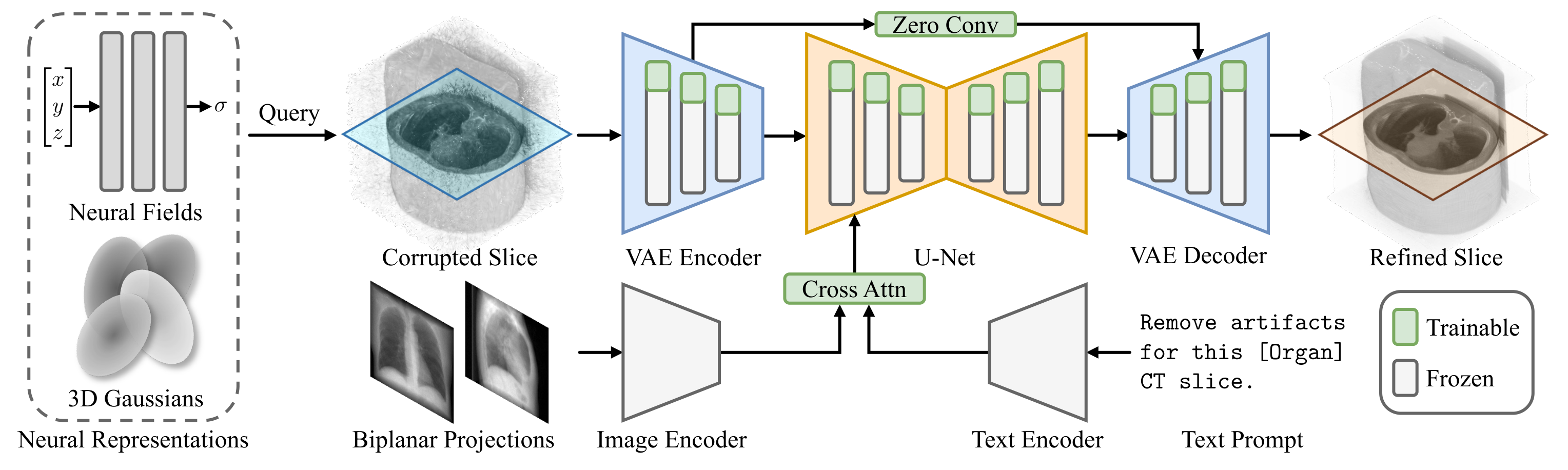
SliceFixer: a single-step diffusion model that corrects artifacts in NR-reconstructed CT slices, conditioned on biplanar X-ray projections and text prompts.
Repair & Augment: periodically optimizing with pseudo-reference volumes under 3D perceptual SSIM supervision, avoiding frequent diffusion queries and hallucinated details.
Data Curation: mixed NR types, varied view distributions, and intentional underfitting to generate diverse artifact patterns for robust SliceFixer training.
Empirical gains: DiffNR improves NR baselines by +2.19 dB (NAF) and +5.79 dB (R2-Gaussian), generalizes to out-of-distribution domains, and boosts downstream segmentation.
1Monash University2The Australian National University3Hong Kong Polytechnic University
Contact: shiyan.su@monash.edu
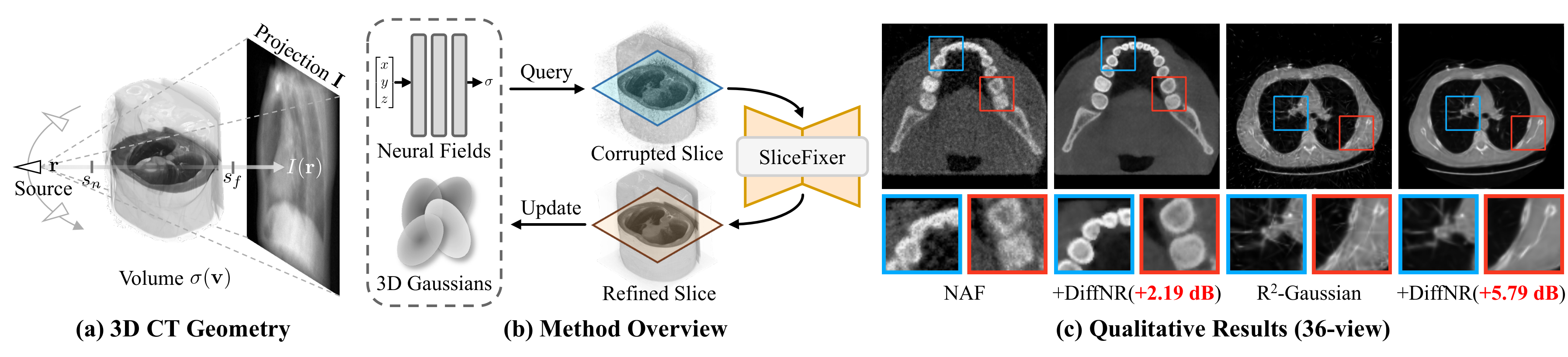
Figure 1: We propose DiffNR for sparse-view 3D CT reconstruction. (a) Geometry of a cone-beam CT scanner. (b) Method overview. (c) Comparison between the baseline methods (NAF, R2-Gaussian) and our proposed DiffNR.
Abstract
Neural representations (NRs), such as neural fields and 3D Gaussians, effectively model volumetric data in computed tomography (CT) but suffer from severe artifacts under sparse-view settings. To address this, we propose DiffNR, a novel framework that enhances NR optimization with diffusion priors. At its core is SliceFixer, a single-step diffusion model designed to correct artifacts in degraded slices. We integrate specialized conditioning layers into the network and develop tailored data curation strategies to support model finetuning. During reconstruction, SliceFixer periodically generates pseudo-reference volumes, providing auxiliary 3D perceptual supervision to fix underconstrained regions. Compared to prior methods that embed CT solvers into time-consuming iterative denoising, our repair-and-augment strategy avoids frequent diffusion model queries, leading to better runtime performance. Extensive experiments show that DiffNR improves PSNR by 3.99 dB on average, generalizes well across domains, and maintains efficient optimization.
Method
SliceFixer
A single-step diffusion model finetuned from SD-Turbo to correct artifacts in NR-reconstructed CT slices, conditioned on biplanar X-ray projections and text prompts.
Data Curation
Tailored strategies including mixed NR types, varied view distributions, and intentional model underfitting to generate diverse artifact patterns for SliceFixer training.
Repair & Augment
SliceFixer periodically generates pseudo-reference volumes with 3D perceptual SSIM supervision, avoiding frequent diffusion queries for efficient optimization.
SliceFixer: Diffusion Model for Slice Repairing
Previous methods in RGB view synthesis repair artifacts at the projection level, which is suboptimal for volumetric reconstruction where errors in penetrable X-ray projections accumulate. SliceFixer instead operates directly on reconstructed CT slices. Built upon SD-Turbo, it takes a corrupted axial slice as input and outputs a refined slice. The model is conditioned on: (1) a text prompt providing semantic guidance (e.g., organ type), and (2) two orthogonal X-ray projections encoded by RAD-DINO, providing global structural cues. We inject LoRA adapters and zero-convolution skip connections for efficient finetuning.
Figure 2: SliceFixer Architecture. It takes as input a CT slice queried from NRs, along with biplanar projections and a text prompt as conditions. It outputs a refined slice without artifacts. The model is built on SD-Turbo, a single-step diffusion backbone. Trainable LoRA layers and zero convolutions are injected to adapt the model.
DiffNR: Diffusion-Enhanced NR Optimization
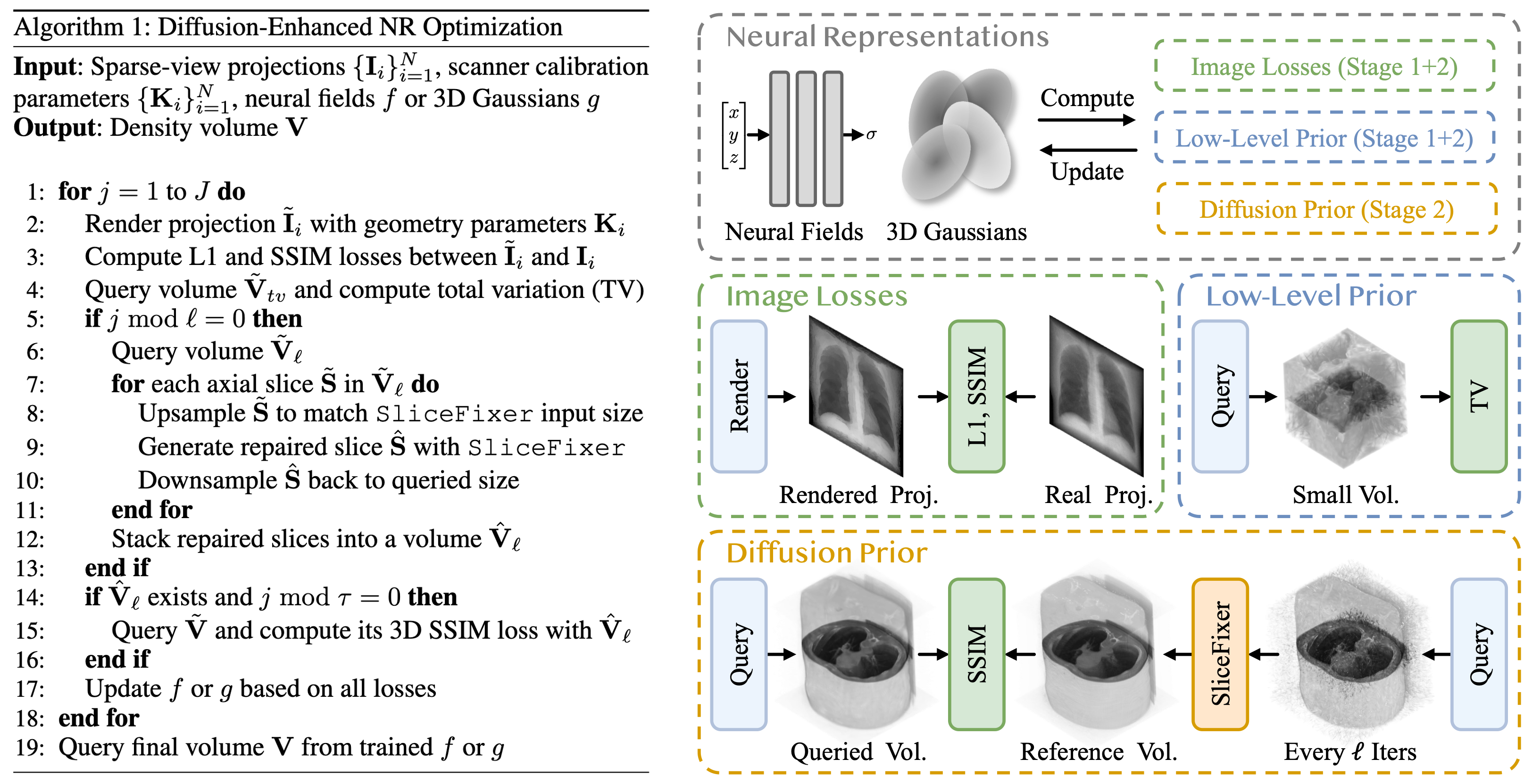
Rather than using SliceFixer as post-processing, we integrate it into the NR optimization loop. The pipeline operates in two stages: Stage 1 optimizes a neural representation (e.g., NAF or R2-Gaussian) using standard image losses (L1 and SSIM) and total variation regularization. In Stage 2, every \(\ell\) iterations, we query a volume from the current model, apply SliceFixer to repair each axial slice, and assemble them into a pseudo-reference volume. This reference volume then provides auxiliary 3D SSIM-based perceptual supervision every \(\tau\) steps. The perceptual loss promotes structural coherence rather than overfitting to potentially hallucinated fine-grained details.
Figure 3: DiffNR Pipeline. During the training, we train neural representations using image losses and low-level regularization. In Stage 2, we generate a pseudo-reference volume with SliceFixer every \(\ell\) iterations, and then apply SSIM regularization on queried and reference volumes.
Unlike prior methods that embed CT solvers into time-consuming iterative denoising, our repair-and-augment strategy avoids frequent diffusion model queries, leading to better reconstruction quality and runtime performance.
Results
In-Distribution Performance
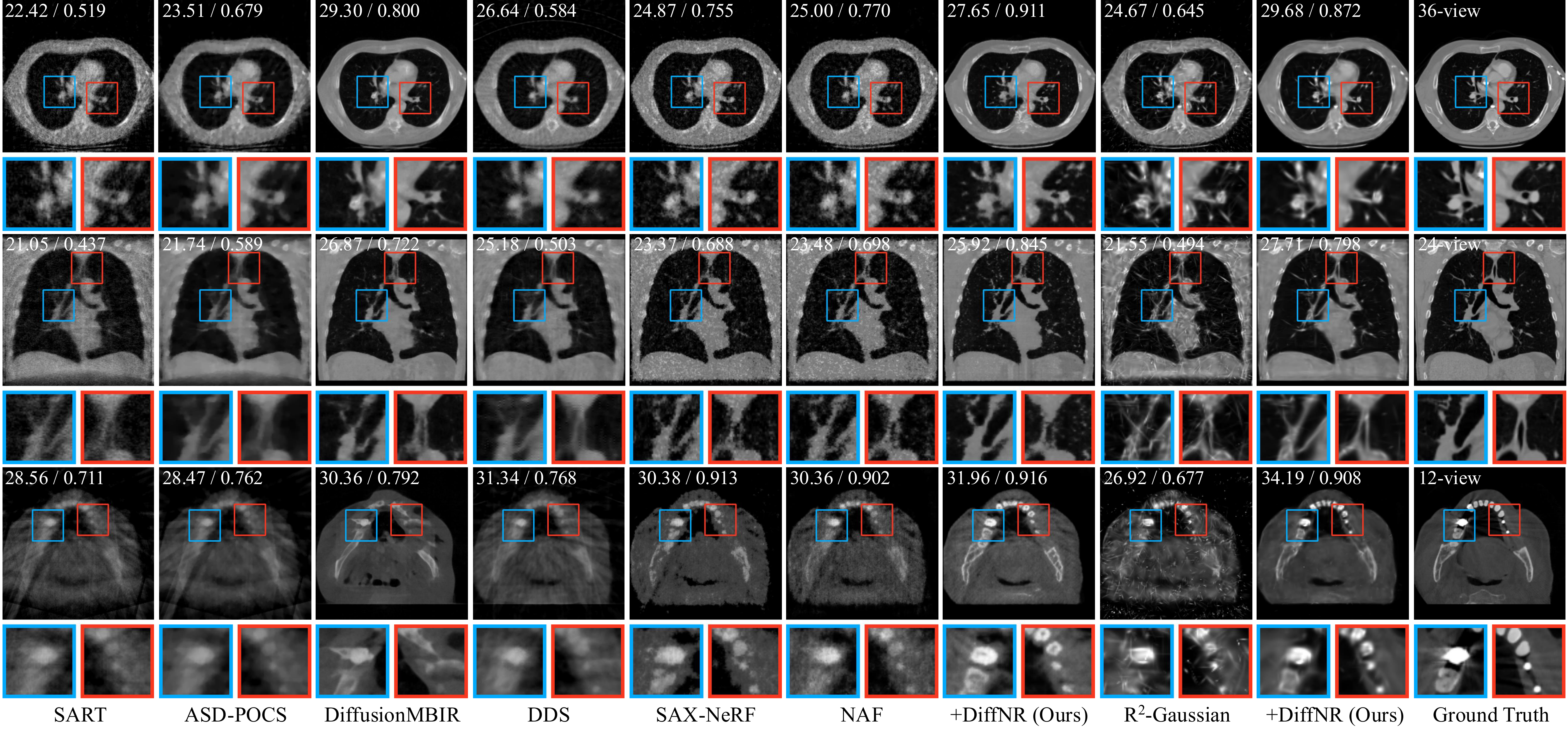
We evaluate DiffNR on two datasets: ToothFairy (dental CT) and LUNA16 (chest CT), under challenging 36-, 24-, and 12-view sparse-view settings. DiffNR consistently enhances NR baselines, yielding an average improvement of +2.19 dB for NAF and +5.79 dB for R2-Gaussian, while remaining substantially faster than prior diffusion-based methods.
Methods
ToothFairy
LUNA16
Time
36-view
24-view
12-view
36-view
24-view
12-view
Traditional Methods
SART
27.41 / 0.581
27.13 / 0.596
25.66 / 0.604
22.34 / 0.438
21.77 / 0.437
19.96 / 0.412
1m25s
ASD-POCS
29.65 / 0.775
28.34 / 0.765
25.91 / 0.721
23.93 / 0.661
22.63 / 0.616
20.04 / 0.512
48s
Diffusion-Based Iterative Methods
DiffusionMBIR
33.29 / 0.856
30.54 / 0.818
26.28 / 0.733
29.35 / 0.781
27.15 / 0.735
23.01 / 0.581
11h15m
DDS
32.56 / 0.817
31.13 / 0.788
28.66 / 0.767
26.21 / 0.554
25.21 / 0.512
23.29 / 0.486
16m17s
Neural Representation Methods
SAX-NeRF
28.48 / 0.835
27.91 / 0.832
26.11 / 0.812
23.72 / 0.704
23.20 / 0.690
21.50 / 0.639
4h9m
NAF
28.62 / 0.833
28.20 / 0.833
26.22 / 0.812
23.85 / 0.712
23.18 / 0.692
21.37 / 0.618
7m15s
+DiffNR (Ours)
31.27 / 0.951
30.79 / 0.946
28.10 / 0.906
26.27 / 0.867
25.15 / 0.839
22.98 / 0.765
8m41s
R2-Gaussian
28.56 / 0.695
26.36 / 0.634
22.63 / 0.537
24.11 / 0.577
22.06 / 0.497
18.32 / 0.364
5m52s
+DiffNR (Ours)
33.52 / 0.900
32.92 / 0.895
29.71 / 0.852
28.82 / 0.822
27.43 / 0.793
24.37 / 0.712
11m35s
Table 1: Quantitative results (PSNR / SSIM) on ToothFairy and LUNA16 datasets. DiffNR consistently improves NR baselines while remaining much faster than diffusion-based iterative methods.
Figure 4: Qualitative results of reconstructed volumes on two datasets, shown from different slicing directions and sparsity levels. DiffNR recovers finer details and effectively suppresses artifacts.
DiffNR improves PSNR by 3.99 dB on average across all settings, while previous SOTA DiffusionMBIR takes 11 hours per case vs. DiffNR's ~10 minutes.
Out-of-Distribution Generalization
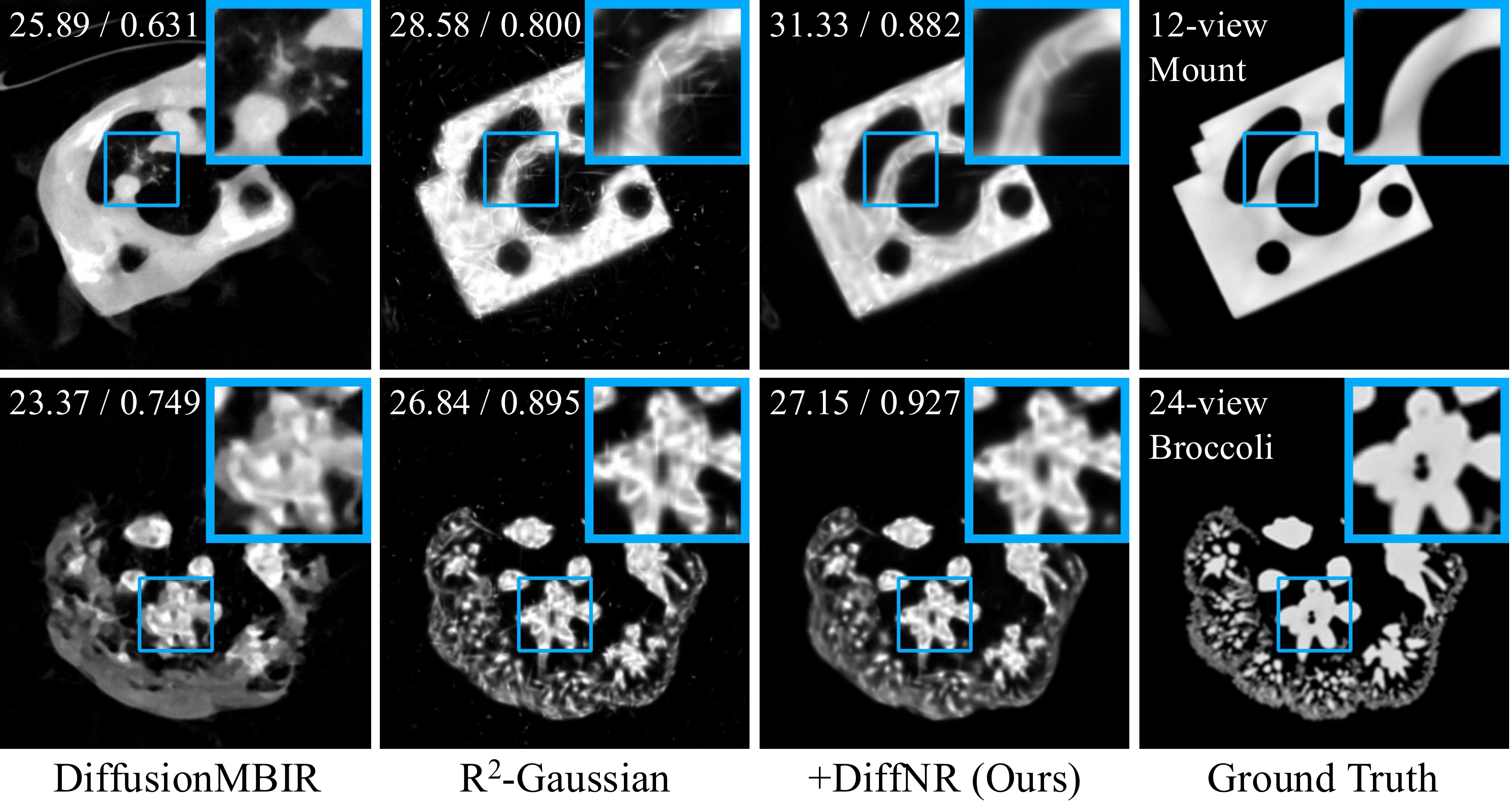
To evaluate generalization, we apply SliceFixer pretrained on ToothFairy to an OOD dataset containing 18 diverse cases spanning human organs, biological specimens, and artificial objects with real-world captured projections. DiffNR outperforms all baselines by suppressing hallucinations and artifacts, demonstrating that SliceFixer learns generalizable artifact patterns rather than dataset-specific features.
Figure 5: Qualitative results on the OOD dataset. DiffNR suppresses hallucinations and artifacts on unseen domains including human organs, biological specimens, and artificial objects.
Ablation Study & Analysis
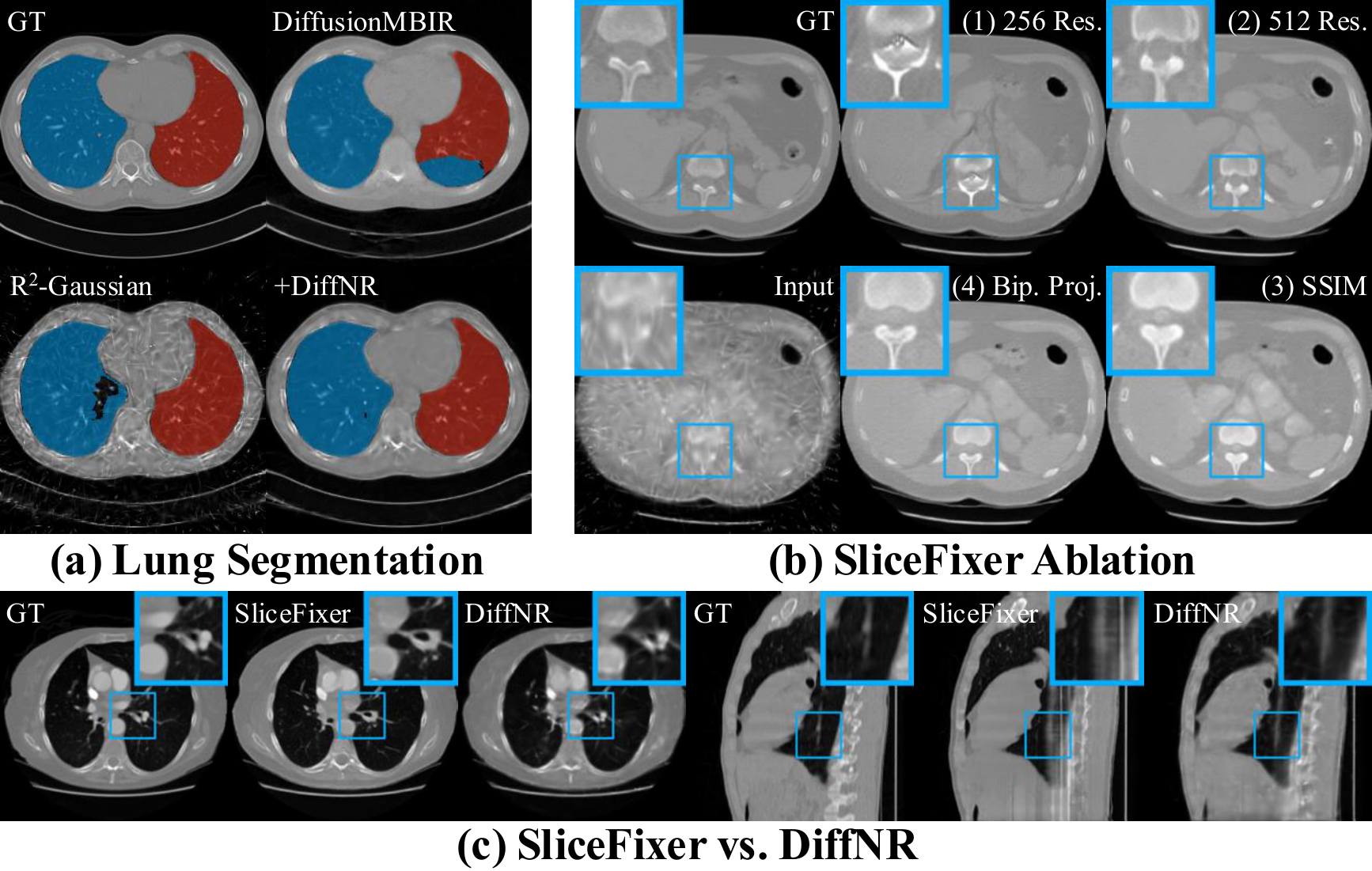
We conduct comprehensive ablation studies to validate the design choices of both SliceFixer and DiffNR. Key findings include: (1) finetuning on 5122 images with up-downsampling outperforms native 2562 resolution; (2) SSIM loss and biplanar projection conditioning each provide significant gains; (3) augmenting slice supervision is more effective than projection-level augmentation for volumetric CT; and (4) integrating SliceFixer into the optimization loop with 3D perceptual SSIM loss is critical to avoid inter-slice jitter and hallucinations from standalone post-processing. We also validate DiffNR on downstream lung segmentation, where it produces substantially more accurate masks.
Figure 6: (a) Lung segmentation with the left lung in blue and the right lung in red. (b) Visualization of different design choices for SliceFixer. (c) Comparison of standalone SliceFixer post-processing and our proposed DiffNR.
BibTeX
@inproceedings{su2026diffnr,
  title={DiffNR: Diffusion-Enhanced Neural Representation Optimization for Sparse-View 3D Tomographic Reconstruction},
  author={Su, Shiyan and Zha, Ruyi and Shi, Danli and Li, Hongdong and Cheng, Xuelian},
  booktitle={Proceedings of the AAAI Conference on Artificial Intelligence},
  volume={40},
  number={11},
  pages={9144--9152},
  year={2026}
}